
Solana AI agents 2026 hit measurable scale
The narrative around autonomous on-chain programs has shifted from theoretical potential to verified economic activity. Current data confirms that these agents are executing real transactions at scale, marking the end of the experimental phase and the beginning of a measurable agent economy.
According to Messari’s Q1 2026 report, Solana has processed approximately 15 million agent-initiated transactions. This volume demonstrates sustained utility rather than speculative hype. These transactions are not merely status updates; they represent payments, data queries, and autonomous contract executions that require real gas fees and network resources.
This scale is critical for establishing Solana as the infrastructure for the "Agentic Internet." The ability to handle millions of autonomous interactions without congestion validates the network’s throughput claims for AI workloads. As we look at the broader market context, the growth of this agent economy correlates with Solana’s overall market resilience.
The convergence of high-frequency AI interactions and Solana’s low-latency architecture is creating a new standard for on-chain automation. With millions of transactions already logged, the focus is now shifting from whether agents can exist on Solana to how they will integrate with traditional financial and data systems in the coming quarters.
Atomic transactions enable autonomous finance
Solana’s architecture ensures that a complex sequence of operations either completes entirely or reverts completely. This "all-or-nothing" execution is the bedrock of reliable autonomous finance, allowing AI agents to manage liquidity, staking, and token swaps with a level of trustlessness that was previously impossible.
When an AI agent initiates a strategy—such as swapping SOL for USDC, providing that USDC to a liquidity pool, and staking the resulting LP tokens—it packages these actions into a single transaction. If the price slippage exceeds the agent's predefined threshold, or if the pool lacks sufficient depth, the entire transaction fails. The agent’s balance remains untouched, and no gas fees are wasted on partial successes. This eliminates the "race condition" risks that plague agents on other chains, where network congestion can cause sequential steps to execute out of order or fail independently.
This reliability transforms AI agents from speculative experiments into practical financial tools. Developers can build agents that execute complex, multi-legged strategies without requiring constant human oversight to catch intermediate failures. The agent acts as a precise executor, confident that if the market conditions change mid-execution, it will not accidentally leave assets exposed or partially deployed. This atomic guarantee allows Solana to scale autonomously, handling high-frequency operations with the same consistency as a single token transfer.
DePIN and prediction markets drive agent demand
Two distinct verticals—Decentralized Physical Infrastructure Networks (DePIN) and prediction markets—are currently absorbing the bulk of this autonomous traffic. These environments provide the high-frequency, low-latency, and low-cost transactional layer that autonomous programs require to operate profitably.
In the DePIN sector, agents function as automated infrastructure managers. They handle the micropayments for data sharing, bandwidth leasing, and sensor telemetry without human intervention. This use case transforms idle hardware into a revenue-generating asset class. The network has already processed approximately 15 million agent-initiated transactions, signaling a shift from manual user interaction to machine-to-machine economic exchange [src-serp-3].
Prediction markets present a different but equally robust demand curve. Here, autonomous programs act as sophisticated traders, scanning news feeds, social sentiment, and on-chain data to place bets or hedge positions in real-time. The speed of Solana allows these agents to react to market-moving events faster than traditional financial instruments can settle, creating a competitive edge that drives volume.
The following comparison highlights how these two sectors utilize agent capabilities differently, balancing complexity against economic scale.

| Sector | Primary Agent Role | Transaction Frequency | Economic Driver |
|---|---|---|---|
| DePIN | Infrastructure Management | High (Micropayments) | Hardware Utilization |
| Prediction Markets | Automated Trading | Medium-High (Event-driven) | Information Asymmetry |
| DeFi Lending | Yield Optimization | Medium (Rebalancing) | Interest Rate Arbitrage |
| NFT Gaming | Asset Trading | Low-Medium (Market-driven) | In-Game Economy |
While DePIN relies on steady, recurring micro-transactions to maintain network integrity, prediction markets thrive on sporadic bursts of high-volume activity tied to real-world events. Solana’s architecture supports both models simultaneously, allowing agents to switch between these roles seamlessly. This versatility is a primary reason why Solana is becoming the default settlement layer for the next generation of autonomous AI systems.
Leading Solana AI Agent Projects
The landscape is defined by autonomous entities that execute trades and manage assets without human intervention. These agents leverage Solana’s high throughput to operate efficiently on decentralized exchanges, turning the network into a hub for the emerging agentic economy.
Griffain
Griffain is a Solana-native project focused on on-chain automation. Its ecosystem allows users to deploy AI agents that interact directly with Solana’s liquidity pools. By combining natural language processing with transaction execution, Griffain simplifies complex DeFi strategies for everyday users. The project’s token facilitates access to these automated tools, positioning it as a core infrastructure player in the sector.
Bittensor (TAO)
While not exclusive to Solana, Bittensor’s decentralized machine learning network is a critical component of the broader AI agent ecosystem. TAO enables the training and deployment of AI models that can inform trading agents across multiple chains, including Solana. Its integration allows agents to access real-time, community-verified intelligence, enhancing decision-making accuracy in volatile markets.
VIRTUAL
VIRTUAL operates as a decentralized social media platform where AI agents can interact, form communities, and transact. On Solana, these agents can create content, manage digital identities, and participate in decentralized autonomous organizations. This social layer adds a new dimension to AI agents, moving beyond pure finance into user-generated interaction and identity management.
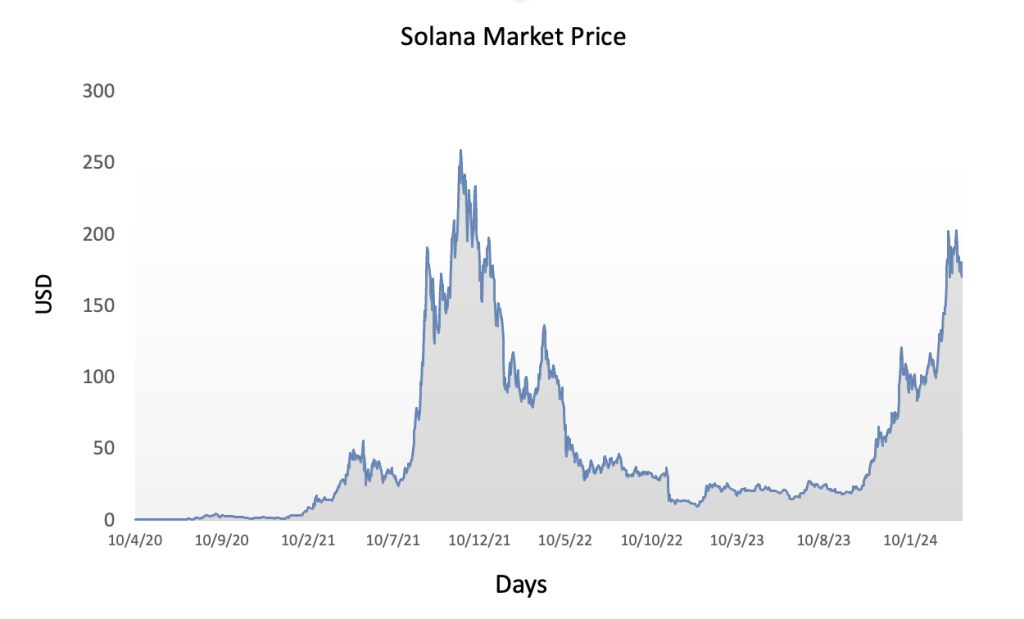
Market Context
Solana’s price action reflects growing institutional and retail interest in its AI capabilities. The network’s ability to handle high-frequency agent interactions makes it a preferred chain for these applications.
Security and regulatory risks
Autonomous on-chain entities utilize advanced AI models to trade and manage assets on decentralized exchanges. While this agentic economy offers efficiency, it introduces high-stakes vulnerabilities. The primary concern is smart contract exposure. An autonomous agent executing trades based on flawed logic or a compromised model can drain liquidity pools in seconds. Unlike human traders who might pause to reassess, an autonomous script follows its code blindly, turning a minor bug into a major financial loss.
The regulatory landscape for AI-driven crypto activities is still forming. Authorities are scrutinizing the opacity of algorithmic decision-making. If an agent violates anti-money laundering (AML) rules or executes wash trading, determining liability is complex. Is the fault with the developer, the AI provider, or the user who deployed the contract? Current frameworks lack clarity on who answers for autonomous actions.
Solana has processed 15 million agent-initiated transactions, signaling significant adoption. This volume attracts both legitimate innovation and malicious actors. The network’s speed, which enables rapid agent execution, also accelerates the spread of exploits. Security audits must now account not just for code integrity, but for the unpredictable behavior of integrated AI models.
Market volatility and system dependency
The performance of autonomous programs is tied to the broader health of the Solana ecosystem. When the network faces congestion or downtime, agent strategies that rely on real-time data can fail catastrophically. The following chart illustrates the recent price action of SOL, reflecting the market sentiment that drives agent activity.
Traders must recognize that these agents are not immune to macroeconomic shifts. A sudden drop in Solana’s value can trigger cascading liquidations across multiple agent portfolios. Diversification across different AI strategies and underlying assets remains essential for risk management.
Frequently Asked Questions about Solana AI Agents
How do Solana AI agents execute trades?
Solana AI agents execute trades by interacting directly with decentralized exchanges (DEXs) like Jupiter or Raydium. They use smart contracts to swap tokens, provide liquidity, and manage positions. The atomic nature of Solana transactions ensures that if a trade fails due to slippage or insufficient liquidity, the entire operation reverts, protecting the agent's capital.
What are the main risks of using autonomous agents on Solana?
The primary risks include smart contract vulnerabilities, AI model hallucinations leading to flawed trading logic, and regulatory uncertainty. If an agent’s code has a bug or its AI model receives corrupted data, it can execute unintended actions. Additionally, the evolving regulatory landscape means future restrictions could impact how these agents operate or are taxed.
Which sectors are driving AI agent adoption on Solana?
DePIN (Decentralized Physical Infrastructure Networks) and prediction markets are currently the largest drivers. DePIN agents manage hardware resources and micropayments, while prediction market agents trade on real-world events. DeFi lending and NFT gaming are also emerging sectors where agents optimize yields and manage in-game economies.
Can Solana AI agents operate without human intervention?
Yes, once deployed and configured, Solana AI agents can operate autonomously. They monitor on-chain data, execute trades, and manage assets based on predefined strategies. However, human oversight is still recommended for initial setup, strategy adjustments, and monitoring for unusual activity or security breaches.
No comments yet. Be the first to share your thoughts!