
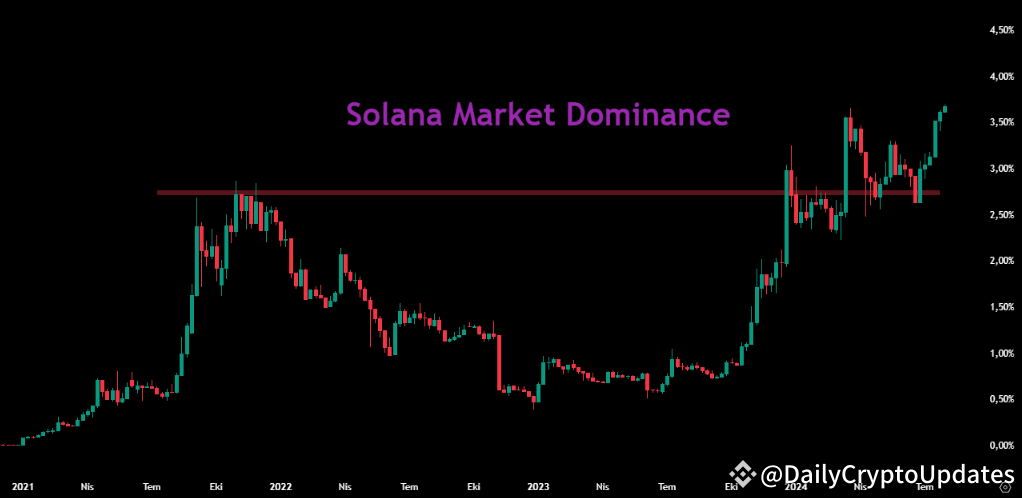
Solana 2026 market snapshot
Solana is trading near $82 in May 2026, anchoring a market capitalization close to $48 billion. Even after the brutal corrections of the previous cycle, the network has stabilized its footing, projecting an average price range of $73.22 for the coming months with potential highs exceeding $125.
The ecosystem’s growth metrics tell a story of institutional maturation rather than just speculative hype. Real-world asset (RWA) tokenization on Solana has reached an all-time high of $2.8 billion, capturing 97% of the tokenized equities market share. This structural depth is supported by a robust $16.4 billion stablecoin supply and record inflows into Solana-based ETFs.
This convergence of price stability and institutional adoption creates a fertile ground for yield generation. As the network processes increasing transaction volumes, the mechanisms for earning returns—particularly through Jito staking and AI-driven agents—are becoming the primary drivers of DeFi activity.
How Jito Staking Works
Jito staking transforms the standard Solana staking model by integrating MEV (Maximum Extractable Value) redistribution directly into the validator workflow. When you stake SOL through a Jito validator, your tokens are not just securing the network; they are also participating in a shared auction for block-building opportunities.
In the 2026 ecosystem, this mechanism creates a distinct yield advantage. Standard staking rewards come from network inflation and transaction fees. Jito adds a third revenue stream: direct MEV payments from searchers who compete to order transactions for maximum profit. These payments are split among the validator, the Jito treasury, and the stakers. This means your base staking yield is supplemented by a variable but often significant MEV bonus.
The process is automated. Jito’s bundle system ensures that MEV rewards are distributed proportionally to stakers based on their stake size. There is no manual claiming required. The combined yield—base staking plus MEV—typically outperforms standard solo staking, making Jito a primary choice for yield-seeking SOL holders.
"Jito effectively turns every block into a shared auction, passing the highest bidder's premium directly back to the staker."
This model relies on the efficiency of Jito’s relay network, which connects validators with searchers. As DeFi activity on Solana grows, the volume of MEV opportunities increases, directly boosting the returns for those who stake through Jito-enabled validators. For a deeper look at how this compares to other methods, see our guide on Solana staking options.
How autonomous agents operate on Solana
Autonomous AI agents are shifting from experimental bots to core infrastructure on Solana. They execute trades, manage liquidity, and interact with DeFi protocols in real-time, often outpacing human reaction speeds. These agents leverage Solana’s high throughput to process thousands of transactions per second, allowing for complex, multi-step strategies that were previously impossible on slower networks.
The rise of AI agents is not just about speed; it is about precision and persistence. Unlike human traders who may hesitate or miss opportunities, AI agents can monitor market conditions 24/7 and execute trades with zero emotional bias. This has led to a surge in sophisticated DeFi interactions, where agents automatically rebalance portfolios, arbitrage price differences across exchanges, and provide liquidity to decentralized markets.
The integration of AI agents with Solana’s native infrastructure, such as Jito staking, further enhances their capabilities. Agents can now automatically optimize staking rewards, reinvest earnings, and manage risk across multiple protocols simultaneously. This level of automation is reshaping DeFi yield, making it more accessible and efficient for both retail and institutional investors.
Community Sentiment and Trends
The mood around Solana in 2026 has shifted from speculative frenzy to cautious optimism. Traders are watching the $82 price level closely, treating it as a baseline rather than a ceiling. The community is less interested in hype and more focused on the utility provided by Jito staking and AI agents. This change in tone reflects a maturing market that values sustainable yield over viral pumps.
Social channels are dominated by discussions on how automated agents are interacting with Solana’s high-throughput network. Users are sharing strategies for maximizing returns through MEV capture, noting that the barrier to entry is lowering. The consensus is that these tools are becoming standard infrastructure, similar to how staking pools evolved over the last cycle.
Reddit threads on r/solana reveal a mix of excitement and scrutiny. While new users are drawn in by the promise of AI-driven yield, veteran holders are demanding transparency on risk management. The community is effectively stress-testing the narrative, ensuring that the technological advancements hold up under market pressure.
This social validation is crucial. It signals that the ecosystem is building for longevity. As the Solana flagship gathering approaches in London this November, the community’s focus on these technical fundamentals suggests that 2026 is about consolidation and real-world application, not just price speculation.
Solana price outlook 2026
Analysts project Solana will trade between $85 and $125 in 2026, with some models averaging closer to $73 for specific months. Prediction markets currently assign a roughly 40% probability of SOL reaching $100 by August 2026. On the downside, the $90 level acts as a critical support zone with a 50% probability of holding.
Technical indicators highlight a bullish crossover between the 20-day and 50-day EMAs, suggesting upward momentum. However, broader market sentiment remains mixed, with some forecasts keeping the yearly range wide to account for potential volatility.
Frequently asked: what to check next
The shift toward Jito staking and AI-driven yield strategies is changing how investors view Solana’s long-term value. Instead of relying solely on price speculation, the ecosystem is building robust infrastructure that supports automated, high-frequency DeFi interactions. This structural change aims to reduce volatility and create more predictable returns for holders.
As Solana continues to attract institutional interest, its role as a high-performance network for internet capital markets becomes clearer. The integration of AI agents into yield farming allows for real-time portfolio adjustments, a feature that traditional blockchains struggle to replicate. This technological edge may be the primary driver for Solana’s projected price appreciation in the coming years.
No comments yet. Be the first to share your thoughts!