
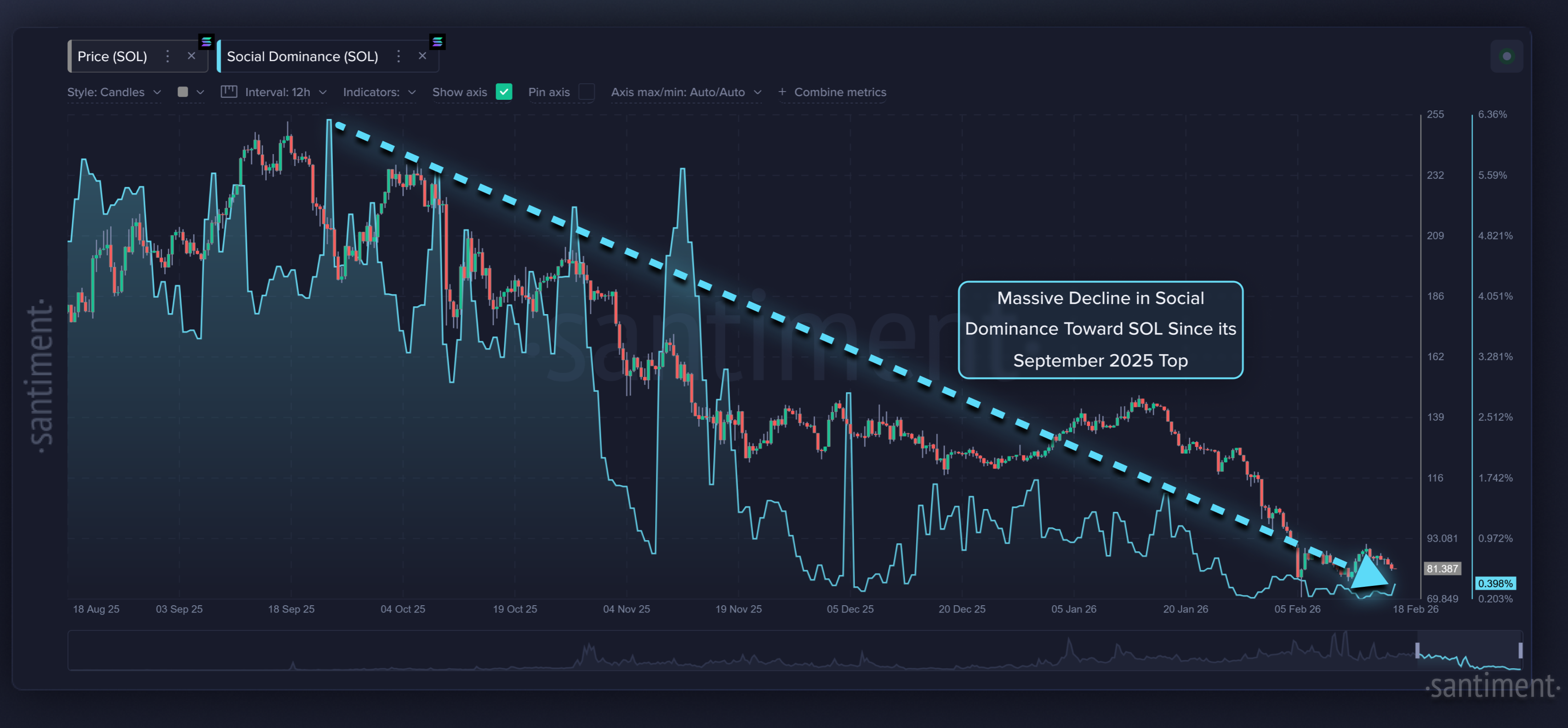
Solana DeFi 2026 market overview
Solana DeFi 2026 is no longer defined by raw throughput numbers, but by the structural shift toward institutional-grade predictability. The narrative has moved beyond chasing headline transactions per second to focus on execution integrity, predictable finality, and network resilience. This transition is what allows Solana to function as general-purpose financial infrastructure rather than just a high-speed consumer chain.
This shift in volume and utility is evident in the ecosystem's growing dominance over legacy competitors. While Ethereum remains a settlement layer, Solana has carved out a distinct niche as a high-performance execution layer that institutions can rely on for daily operations. The 2026 roadmap emphasizes hardening the network into a stable rail, reducing the volatility of transaction costs and confirmation times that previously hindered serious financial adoption.
To understand the momentum driving this adoption, it is helpful to look at the price action and market sentiment surrounding the native asset. The correlation between network stability improvements and institutional inflows suggests that Solana DeFi 2026 is maturing into a robust alternative for large-scale financial applications.
The focus on fairness and redundancy in the 2026 technical roadmap signals a clear departure from the "move fast and break things" era. Financial institutions require certainty, and Solana's recent upgrades are designed to provide that certainty. This reliability is becoming the primary driver for the volume shift, as more capital moves from experimental DeFi protocols to established, resilient platforms.
As the ecosystem matures, the distinction between Solana and other layer-one chains becomes less about speed and more about usability and trust. The result is a DeFi landscape in 2026 that is increasingly dominated by Solana for applications where speed, low cost, and institutional reliability are non-negotiable.
Top Solana DeFi protocols by TVL
The Solana DeFi landscape in 2026 is defined by a clear hierarchy of capital concentration. While the ecosystem supports a wide array of applications, institutional and retail liquidity has consolidated around a handful of foundational protocols. Identifying these leaders requires looking beyond simple market caps to understand where the actual economic activity—trading volume, lending supply, and yield generation—is occurring.
Kamino Finance currently stands as the largest single Solana DeFi protocol by Total Value Locked (TVL), holding approximately $1.48 billion as of late April 2026. This dominance stems from its role as the primary lending and borrowing hub, providing the deep liquidity pools that other applications rely on for leverage and yield strategies. Following Kamino, Jupiter operates as the essential liquidity layer, aggregating trades across the entire ecosystem to minimize slippage and maximize price efficiency for users.
Raydium and Jito represent the next tier of critical infrastructure, each serving distinct but equally vital functions. Raydium remains the leading automated market maker (AMM) for spot trading and liquidity provision, particularly for new token launches. Meanwhile, Jito has carved out a unique niche by capturing MEV (Maximal Extractable Value) and integrating liquid staking, offering a yield-bearing version of SOL that has become a staple for institutional portfolios seeking exposure without sacrificing liquidity.
The following comparison outlines the key metrics for these four protocols, highlighting their specific utility and market position within the Solana ecosystem.
| Protocol | Category | TVL (Approx.) | 30d Volume |
|---|---|---|---|
| Kamino | Lending & Yield | $1.48B | $12.5B |
| Jupiter | DEX Aggregator | $1.12B | $45.2B |
| Raydium | AMM & Launchpad | $850M | $8.1B |
| Jito | Liquid Staking & MEV | $1.35B | N/A |
Understanding these distinctions helps clarify why these specific protocols are the center of gravity for Solana DeFi. Kamino and Jupiter handle the bulk of capital movement, while Raydium and Jito provide the necessary infrastructure for trading and staking. As the network continues to harden its technical roadmap toward predictable finality and execution integrity, these established players are best positioned to absorb the increasing institutional volume expected in 2026.
Shifting from speed to stability
The 2026 Solana roadmap marks a decisive pivot away from chasing headline transactions per second (TPS) metrics. Instead, the network is hardening its infrastructure to prioritize predictability, resilience, and execution integrity. This shift transforms Solana from a high-throughput experimental chain into a reliable financial rail suitable for institutional capital.
For financial institutions, raw speed is secondary to the certainty that a transaction will execute exactly as specified without unexpected reverts or latency spikes. The focus now rests on predictable finality and robust redundancy, ensuring that high-stakes settlements do not fail due to network congestion or validator inconsistencies.
This structural evolution supports the growth of general-purpose DeFi rails. Recent ecosystem developments, including deeper lending markets and improved execution formats, demonstrate that the network can handle complex financial instruments with the same reliability required for traditional finance.
The transition signals that Solana is ready for serious institutional adoption. By emphasizing stability and fairness, the network removes the technical risks that previously kept large-scale financial players on the sidelines.
Solana vs Ethereum TVL dynamics
The volume shift between Solana and Ethereum is no longer just about raw speed; it is a structural migration of liquidity toward predictable, low-friction infrastructure. While Ethereum remains the settlement layer for institutional-grade assets, Solana has captured the high-frequency trading and consumer DeFi volume by eliminating the gas friction that historically fragmented user experience.
This divergence is visible in the Total Value Locked (TVL) composition. Solana’s largest single protocol, Kamino Lend, held approximately $1.48 billion in TVL as of late April 2026, according to DefiLlama data. This concentration demonstrates how Solana’s architecture supports deep, liquid markets without the capital inefficiency caused by Ethereum’s multi-layered fragmentation. The ecosystem is consolidating around high-throughput aggregators like Jupiter, which routes orders to minimize slippage, creating a user experience that feels closer to centralized exchanges than traditional DeFi.
The technical roadmap for 2026 reinforces this institutional pivot. Rather than chasing theoretical transaction per second (TPS) headlines, the focus has shifted to predictable finality and execution integrity. For institutions, this reliability is more valuable than peak throughput. Solana is positioning itself not as a speculative high-speed chain, but as a robust infrastructure layer capable of handling institutional volume with deterministic costs.
Ultimately, the TVL dynamics reflect a segmentation of labor. Ethereum secures the value; Solana processes the volume. As gas fees on Ethereum remain volatile and capital-intensive, liquidity continues to flow toward Solana for activities where speed and cost predictability are non-negotiable, such as market making, high-frequency trading, and consumer-facing applications.
Solana DeFi 2026: Key risks and future outlook
The shift toward institutional adoption on Solana introduces a new set of trade-offs. While the 2026 roadmap prioritizes predictable finality and execution integrity over raw throughput, it also raises questions about price floors and long-term viability as the network matures. Investors must weigh the benefits of stability against the inherent volatility of crypto infrastructure.
Institutions require more than speed; they demand resilience. As Solana hardens its rails to serve as reliable infrastructure, the ecosystem is moving away from speculative hype toward sustainable utility. This transition is critical for maintaining liquidity and trust in high-stakes DeFi environments.
To understand the current market positioning, review the live performance of Solana against broader market trends.
No comments yet. Be the first to share your thoughts!